
Workshop Narrative: the Amdahl Executable
Last updated on 2026-03-02 | Edit this page
Overview
Questions
- What is the central example in an HPC Carpentry workshop?
- What does the Amdahl program do?
- Why do we need
amdahlwhen there are lots of parallel applications out there? - How do I install the amdahl package?
Objectives
After this episode, Instructors will be able to…
- Describe the story we tell to guide learners through an HPC Carpentry workshop.
- Describe what the Amdahl executable does.
- Install the Amdahl executable.
Amdahl’s Law
Amdahl’s Law is an important idealization in the field of parallel computing. Generally speaking, the purpose of parallelizing a program is to spread the computational work across multiple processing units to increase performance.
In strong scaling, the success of parallelization scheme is measured by the speed-up, which is to say, the ratio of the amount of time it takes to complete the task with no parallelization, to the amount of time it takes with some degree of parallelization \(n\).
If the program parallelizes perfectly, then this speedup is simply \(1/n\).
Amdahl’s law describes how this applies to the simplest non-ideal program. It assumes that only some fraction of the code can be parallelized perfectly (the “parallel part”), and that a fixed fraction of the code is intrinsically serial. In real-world codes, the serial part might involve problem set-up or tear-down, or data aggregation steps that integrate the resulsts of the parallel tasks.
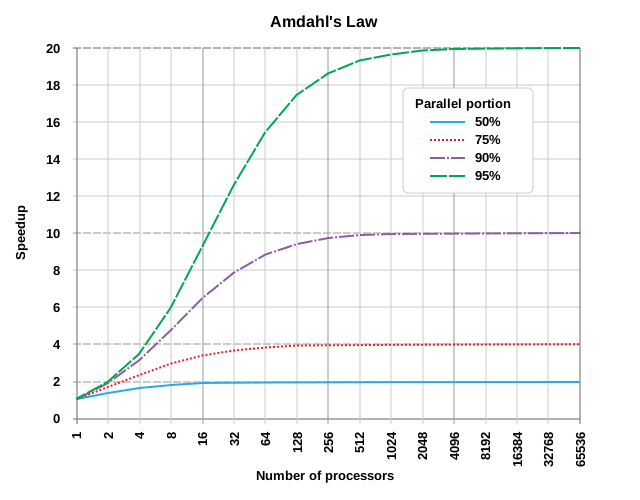

In this case, there are diminishing returns to increasing the degree of parallelization, and after a point, developer effort is better invested in other performance strategies, such as speeding up the serial part of the program, or selecting a better algorithm.
In the HPC Intro lesson, the law is derived, and is written as \(T(n) = (1-p)T + (p/n)T\), where \(T\) is the serial run-time of the program, \(p\) is the parallel fraction of the program, and \(n\)” is the degree of parallelism. It’s clear by inspection of the equation that as \(n\) becomes large, \(T(n)\) becomes approximately equal to the duration of the serial part, \((1-p)T\), and increases in \(n\) only have a small effect on the runtime.
The “speedup” for a given degree of parallelization \(n\) is \(T(1)/T(n)\).
The Amdahl’s Law Executable
The HPC Carpentry development team has provided an executable, called
amdahl, that illustrates this law at low computational
cost, and is easy to run even on very small educational clusters.
The program divides a fixed amount of execution time (given in
seconds by an argument, -w, which defaults to 30 seconds)
into a parallel fraction (given by another argument -p,
which defaults to 0.8) and a serial fraction (equal to \(1-p\), inferred from the -p
argument).
The program takes another argument, -np, which tells it
the degree of parallelism to use.
Then, what it actually does is sleep (go into a wait state) for the
amount of serial run-time that has been inferred from the arguments. MPI
jobs have a number of parallel processes, called “rnaks”, equial to the
value of the -np argument. After the serial sleep process
completes, each of these ranks also sleeps for an amount of time equal
to the parallel run-time divided by the number of ranks.
By default, the program adds a certain amount of jitter to the
results, so that they don’t necessarily exactly lie on the Amdahl’s law
curve. The amount of jitter can be set (as a fraction of the total
run-time) by the -j argument, or disabled entirely with the
-e (for “exact”) argument.
The program then outputs the number of ranks and the duration of the
run-time. Depending on the -t flag (for “terse”), the
output is either human-readable plain text (the non-terse case) or a bit
of JSON suitable for machine ingestion.
The expectation is that learners will use the non-terse output initially in HPC Intro, to get a feel for the diminishing returns of parallelization, and then use the JSON output format to do an automated scaling study and create a plot in the HPC Workflows lesson.
Obtaining the Amdahl Code
The source code is available on a repository on the HPC Carpentry’s GitHub project. It’s a Python code written to use the parallel Message Passing Interface library, which is a dependency of it.
It is also registered with the Python package index, PyPI, and so can
be installed via pip.
Alternatively, if your cluster uses the EESSI software suite, the Python Amdahl code is available there also.
For clusters where users are unable to download files from the
internet, it’s possible to download the pip package and
install it directly. TODO: Is this true?
Whichever scheme is used to install it, the installation should take
place in an environment where the mpi4py Python
functionality is available. This may be available by default on your
cluster, or you may need to load some combination of Python and MPI
modules for it to be available.
- HPC Carpentry workshops are centered on an exploration of Amdahl’s law of scaling, illustrating the diminishing gains of increasingly parallelisation.
- Amdahl is a Python executable that runs for a specified amount of time but does nothing else.
-
amdahlis in the Python package index (pip install amdahl) as well as the EESSI virtual filesystem -
amdahldepends onmpi4pyand a working MPI installation!